
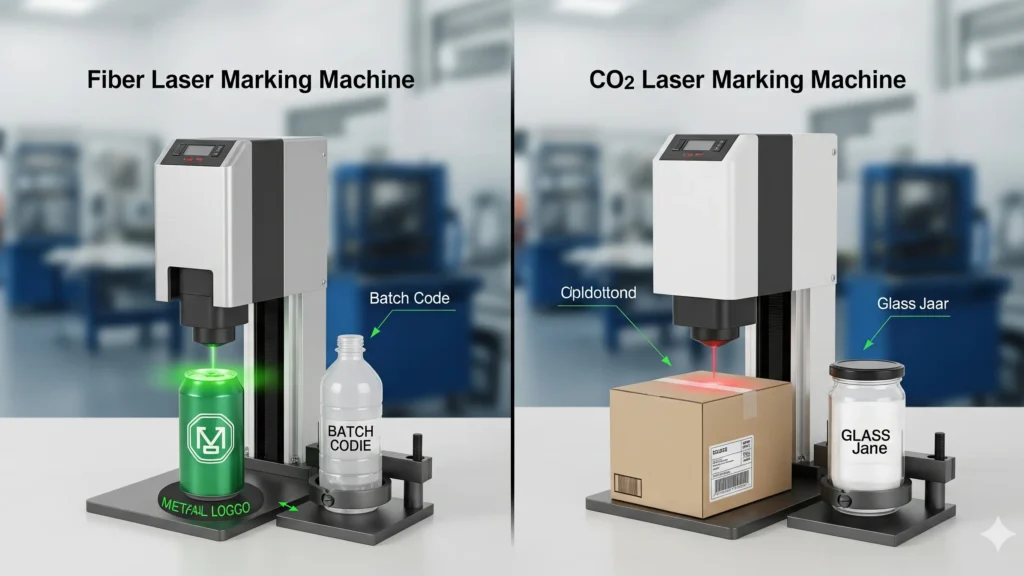
Choosing a laser marking machine can feel like a daunting task, especially with so many options available. For businesses in the food, beverage, and packaging industries, selecting the right technology is crucial for efficiency, compliance, and long-term cost-effectiveness. The two most common types of laser markers are fiber laser marking and CO2 laser marking. So, which one is the perfect fit for your specific needs?
This laser marking machine buyer’s guide will break down the key differences between these two powerful technologies, helping you understand how to choose a laser marker that’s right for you.
Understanding the Core Technology: Fiber vs. CO2
Before we dive into the details, let’s understand how each laser works.
- Fiber Laser Markers use a high-powered fiber optic cable to generate the laser beam. This beam is then directed and focused onto the material. They are known for their precision and high intensity.
- CO2 Laser Markers use a sealed tube filled with carbon dioxide gas. An electrical current is passed through the gas, which excites the CO2 molecules and generates the laser beam. They have a longer wavelength than fiber lasers, making them suitable for different materials.
Now, let’s compare them head-to-head on the most important factors.
Laser Marking Machine Selection: Material Compatibility is Key
The most critical factor in your laser marking machine selection is the type of material you need to mark.
When to Choose a Fiber Laser Marker
Fiber lasers are the undisputed champions for marking metals and some plastics. Their shorter wavelength makes them incredibly effective at creating high-contrast, permanent marks on:
- Stainless steel and aluminum cans: Ideal for marking expiration dates, lot codes, and logos on beverage cans.
- Anodized aluminum and painted metal parts: Perfect for durable marking on industrial equipment components.
- Certain plastics: Including some polycarbonates, ABS, and nylon, which are commonly used in packaging.
For the food and beverage industry, this means they’re the go-to solution for direct marking on metal containers and certain plastic caps and bottles.
When to Choose a CO2 Laser Marker
CO2 lasers are the workhorses for marking a wide range of organic and non-metal materials. Their longer wavelength makes them ideal for:
- PET plastic bottles: A staple in the beverage industry for marking best-by dates and batch codes.
- Glass bottles and jars: Creating frosted, clean marks on wine, beer, and food jars.
- Paper, cardboard, and packaging films: Essential for marking on cartons and flexible packaging.
- Wood, leather, and textiles: Widely used in other industries but also applicable for certain packaging applications.
If your primary need is marking on plastic bottles, glass, or cardboard boxes, a CO2 laser is likely your best option.
Speed and Efficiency: A Race to the Finish
In high-volume production lines, every millisecond counts. Both technologies are fast, but their speed varies depending on the application.
- Fiber lasers are generally faster for deep engraving or marking on metal due to their higher peak power. They can apply complex codes and logos at incredible speeds.
- CO2 lasers are exceptionally fast for high-speed marking on plastic films and paper labels, where a high-contrast mark is created with minimal material interaction.
For applications like marking fast-moving production lines for beverage cans or flexible packaging, both can deliver top-tier performance. The choice comes down to the material being marked.
Cost-Effectiveness and Maintenance: Long-Term ROI
Beyond the initial purchase price, considering long-term costs is a crucial part of any laser marking machine buyer’s guide.
- Fiber lasers have an extremely long lifespan, with the fiber source lasting over 100,000 operating hours. They are also virtually maintenance-free, with no consumables to replace. This makes their total cost of ownership very low.
- CO2 lasers also offer a long lifespan, but the sealed CO2 tube will eventually need to be replaced, typically after 20,000 to 45,000 operating hours. This is a significant cost, but the tube replacement process is straightforward.
While the initial cost of a CO2 laser might be slightly lower, the minimal maintenance and extreme longevity of a fiber laser often make it the more economical choice in the long run, especially for high-volume operations.
Synmark Laser Can Help You Make the Right Choice
Choosing between fiber and CO2 laser marking is a decision that requires careful consideration of your specific materials, production speed, and budget. At Synmark Laser, we specialize in providing cutting-edge laser marking solutions tailored for the food, beverage, and packaging industries.
Our team of experts can help you analyze your application and recommend the ideal laser technology, ensuring you get a high-quality, reliable, and cost-effective solution. Don’t leave your marking needs to chance.
Ready to find the perfect laser marking solution for your business?
Contact Synmark Laser today for a free consultation. Let us help you boost your productivity, ensure compliance, and secure your long-term success.