
Product Description
Principle: The core of the device is a fiber laser. A pump source couples energy into a gain fiber, causing particles within the fiber to undergo energy level transitions and population inversion, generating a high-energy-density laser beam with a wavelength of 1064nm. This laser beam is transmitted via the optical fiber to the marking head. Under precise control of the control system, the galvanometer scanning system within the marking head rapidly changes the laser beam’s scanning direction based on pre-set patterns, text, and other information, focusing the laser beam on the workpiece surface on the assembly line. The laser energy is absorbed by the workpiece surface material, causing it to rapidly vaporize or change color, creating a permanent mark.
Components
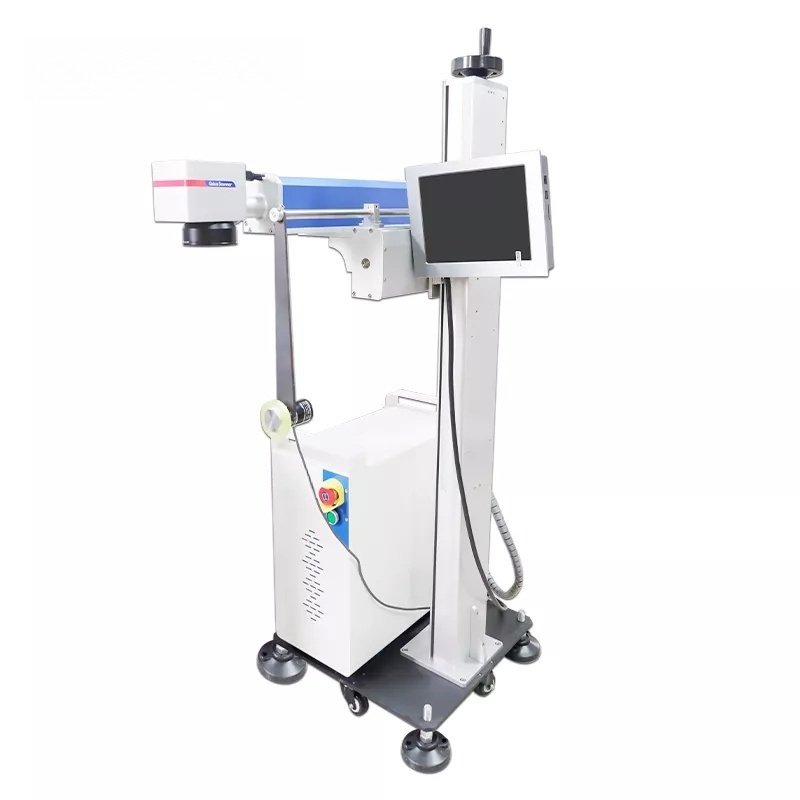
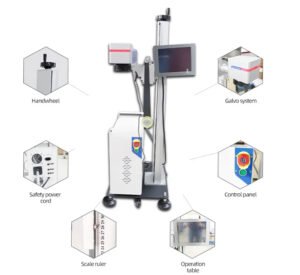
Laser Generation System: Primarily composed of a 20W fiber laser and a driver. The laser generates a stable laser beam, while the driver provides stable power to the laser, ensuring its proper operation.
Marking Head: Contains components such as the galvanometer scanning system and focusing lens. The galvanometer scanning system quickly and precisely controls the laser beam’s scanning path, while the focusing lens focuses the laser beam on the workpiece surface, ensuring accurate and effective marking.
Control System: Consists of control software and control circuitry. The control software runs on a computer or dedicated controller, allowing users to edit marking content and set marking parameters such as power, speed, and frequency. The control circuit coordinates the operation of various components to ensure stable equipment operation.
The mounting bracket is used to secure the marking machine to the assembly line. It can be flexibly adjusted to the height and width of the assembly line to ensure the appropriate distance and angle between the marking head and the workpiece surface.
Product Features
High-speed on-the-fly marking: It integrates seamlessly with the production line, enabling marking while products are moving at high speeds. Maximum linear marking speeds reach over 8000mm/s, while production line speeds can reach up to 120m/min, significantly improving production efficiency.
High-precision marking: With repeatability of up to 0.01mm and a minimum line width of 0.03mm, it can clearly mark fine text, intricate patterns, and high-resolution QR codes.
High stability: Utilizing an industrial-grade fiber laser, it offers a long mean time between failures (MTBF) and continuous, stable operation 24/7. Combined with a sophisticated heat dissipation system and high-quality circuit design, the device provides stable and reliable performance.
High electro-optical conversion efficiency: With an electro-optical conversion efficiency exceeding 30%, it offers significantly lower energy consumption and energy savings compared to other laser marking machines, reducing operating costs.
Consumable-free processing: No consumables such as ink or other consumables are required, and no harmful emissions are emitted, reducing production costs while complying with environmental regulations. Easy to operate: The control software has a friendly interface and is easy to operate. Users can quickly get started after simple training and easily complete various marking tasks.
Applicable Materials
Metal materials: This includes most metals, including stainless steel, carbon steel, aluminum alloy, copper, iron, gold, silver, and platinum. These materials can be used to mark product information such as model numbers, serial numbers, production dates, and security codes.
Some non-metallic materials, such as engineering plastics and opaque plastics and rubber, can also be marked to identify brand, specifications, and intended use.