Your current product identification method isn’t cutting it. Maybe your labels peel off, your ink smudges, or you simply need a more permanent, professional-looking solution for traceability. You’ve determined that a laser marking machine is the answer—a fantastic decision that will elevate your quality, efficiency, and brand perception.
But here’s the challenge: a quick online search for “laser marking machine” reveals an overwhelming array of options. How do you sift through the noise and find the perfect system for your specific needs without overpaying for features you don’t need or, worse, investing in a machine that can’t handle your materials?
The key is to approach this purchase not as a simple transaction, but as a strategic investment. The right questions will illuminate the path to the ideal machine. This practical laser marking machine buyer’s guide is designed to give you that clarity.
Here are the 5 critical questions you must ask yourself and your potential supplier before making a purchase.
Question 1: What Materials Do I Need to Mark? (This is THE Most Important Question)
The type of material you work with is the single greatest factor determining the kind of laser you need. Not all lasers interact with all materials in the same way.
Fiber Lasers: The industry workhorses. They are exceptionally well-suited for marking metals (stainless steel, aluminum, titanium, brass) and certain plastics. They produce high-contrast, permanent marks like serial numbers, QR codes, and logos with incredible precision and speed. If your work is primarily with metals, a fiber laser marker is almost certainly your best bet.
CO2 Lasers: These are the masters of organic materials and plastics. They are ideal for marking wood, leather, glass, acrylic, paper, cardboard, and certain textiles. They are also excellent for engraving and cutting applications.
UV Lasers (Green Lasers): The “cold mark” specialists. These lasers are perfect for sensitive materials that are susceptible to heat damage. They create high-contrast marks on plastics (especially white ABS), glass, silicone, and certain coated metals without causing thermal stress or burning.
Actionable Tip: Make a comprehensive list of every material you mark now and any materials you might use in the future. Present this list to your laser provider. A reputable company like Synmark Laser can provide material test reports and even process samples for you to see the results firsthand.
Question 2: What is My Required Marking Quality and Speed?
This question balances your quality standards with your production demands.
Quality (Resolution, Contrast, Depth): What does a “good mark” mean for you? Is it a shallow, high-contrast annealed mark on surgical steel? A deep engraving on a nameplate? A subtle, scannable Data Matrix code on a microchip? Consider the legibility, aesthetic finish, and durability required.
Speed (Throughput): How many parts do you need to process per hour? Are you running a high-volume production line where every second counts, or are you a job shop that handles smaller, customized batches? Laser marking speed is influenced by the complexity of the design, the marking area, and the desired depth. A higher-powered laser can often achieve the same mark faster than a lower-powered one.
Actionable Tip: Define your minimum acceptable quality standard and your target parts-per-hour rate. This will help narrow down the laser source power and galvo system speed you require.
Question 3: What is My Integration and Automation Vision?
Is the laser marker going on a bench-top for manual operation, or does it need to be part of a fully automated assembly line? Your answer dramatically changes the type of system you need.
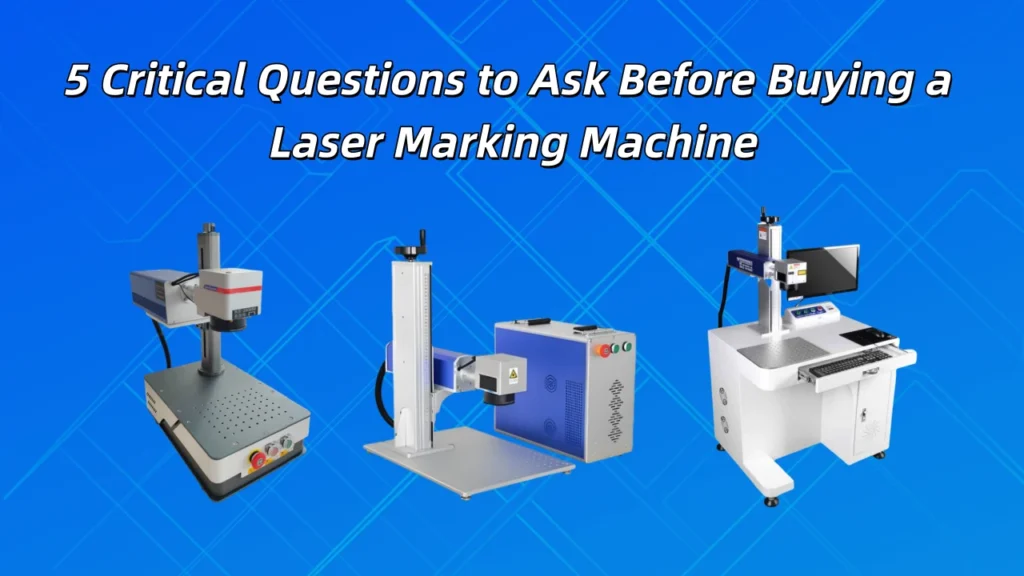
Desktop Systems: Perfect for R&D labs, job shops, and low-volume manual operation. They are versatile and user-friendly.
Integrated Systems: These are designed to be incorporated into production lines. They may include conveyor belts, rotary stages for cylindrical parts (like bottles or pipes), automated loading/unloading robots, and sophisticated software that communicates with your factory’s MES (Manufacturing Execution System).
Actionable Tip: Think about your workflow. Even if you’re starting with a manual system, consider a provider whose machines can be upgraded with automation options later. Synmark Laser offers scalable solutions that grow with your business.
Question 4: What is My Total Budget? (Not Just the Machine Price)
It’s easy to focus solely on the upfront sticker price, but a wise buyer considers the Total Cost of Ownership (TCO).
Upfront Cost: The price of the machine itself.
Installation & Training: Does the price include on-site setup and comprehensive operator training?
Maintenance & Consumables: What is the expected lifespan of the laser source? What are the costs of replacement parts? Fiber lasers have minimal consumables compared to CO2 lasers (which require periodic gas refills and tube replacements), making them very cost-effective over time.
Energy Consumption: Fiber lasers are highly energy-efficient, often using a fraction of the power of other laser types.
Warranty and Support: A robust warranty and accessible technical support are invaluable. Downtime costs money.
Actionable Tip: Ask potential suppliers for a detailed breakdown of costs and a clear explanation of their warranty and support services. Investing in a reliable machine from a company with strong support saves money and headaches in the long run.
Question 5: What Level of Software and Support Do I Need?
The laser hardware is only half of the equation. The software controls it, and the support ensures it keeps running.
Software: Is the software intuitive and easy to learn? Does it support all the file types you use (AI, DXF, PLT, BMP, etc.)? Can it import data from Excel or databases for variable serialization and barcoding? Can it be networked for remote operation?
Training & Support: Does the supplier offer thorough training? Is technical support available locally or 24/7? How are service calls handled?
Actionable Tip: Request a software demo. A user-friendly interface drastically reduces the learning curve and minimizes operator error. Choose a partner, not just a vendor. Synmark Laser provides industry-leading software and unparalleled customer support, ensuring you get the most out of your investment from day one.
Make an Informed Choice with Synmark Laser
Navigating how to choose a laser marker can be complex, but by answering these five questions, you transform from a confused buyer into an informed decision-maker.
You deserve a solution tailored to your unique challenges, not a one-size-fits-all machine. You need a partner who will listen to your needs and provide a reliable, high-performance system.
That’s where we come in.
Synmark Laser is a leading manufacturer of high-precision laser marking systems. We don’t just sell machines; we provide complete marking solutions backed by expert guidance and world-class support.
Ready to find your perfect laser marking machine?
Download our Detailed Specification Sheet to compare models.
Send us a sample of your material. We will process it for you and send a video of the results—absolutely free and with no obligation.
Schedule a Free Virtual Consultation with our application experts to discuss your requirements and get a personalized recommendation.
Don’t guess. Be sure. Contact Synmark Laser today and let us help you make a choice you can be confident in for years to come.